Token Dossier
Ethereum ($ETH), taken apart the way the desk does.
Ethereum (ETH) Token Dossier · Token edition, as of 2026-11-13
The ETH dossier is the desk's Ethereum teardown written out as a document, with the figures a short video cannot hold in one place: the token in numbers, the supply in circulation against the total and the maximum, the protocol's fees and revenue where they are tracked, and the level map rebuilt from the latest price. A token files no quarterly report, so this is a shorter document than a stock dossier, and it is priced as such.
Look inside before you buy
1,285 words · about 6 min to read · 10 sections · data as of 13 November 2026
Table of contents
- What is in this dossier
- What this is not
- 1. The teardown
- The setup
- The network
- The usage
- What it earns
- Why fees fell
- The burn
- The supply
- The case against
- The chart: Thursday's close
- The verdict
- 2. What changed since it was written
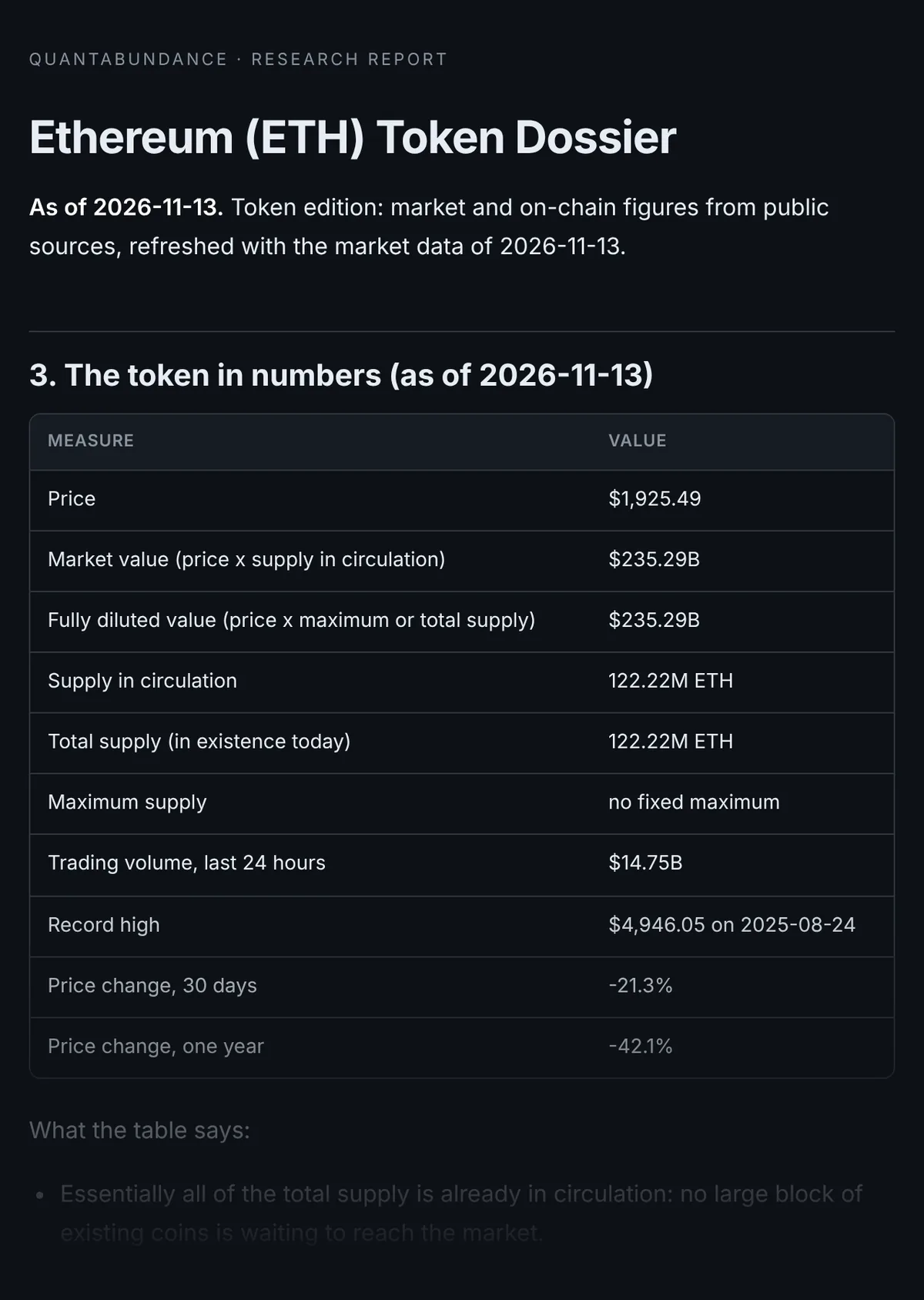
- 3. The token in numbers (as of 2026-11-13)
- 4. Fees and revenue of the protocol
- 5. The level map (as of 2026-11-13)
- 6. Sources
- 7. What this dossier cannot do
- More dossiers in this theme
Excerpt
1. The teardown
Written 2026-10-30, with prices as of 2026-10-30. Figures in this part are as the desk read them that day; parts 2 to 5 carry the numbers as of 2026-11-13.
The setup
Ethereum was called ultrasound money, because its burn was meant to shrink the supply. Over the last year, the supply grew by about 1.4 million Ether. Fees on the network fell about 80%. Ether closed Thursday at $2251, down 42% in a year.
The network
It is the second largest crypto network, and the main home of decentralized apps and stablecoins. Ether, its token, pays the fees and secures the chain through staking. At Thursday's close, all Ether in circulation was worth about $273 billion. On Hyperliquid, Ether perpetual futures hold about $2.3 billion of open interest.
The usage
The usage. The data site DefiLlama tracks the money parked in apps on a chain. On Ethereum, that figure is about $43 billion today. A year ago, it was about 86 billion, so it halved. Stablecoins on Ethereum fell from about $163 billion to about 142 billion. That is still more than any other chain holds.
What it earns
What it earns. Over the last twelve months, users paid about $181 million in fees on Ethereum. In the twelve months before that, they paid about 903 million. Fee income fell by about 80%. Over the last thirty days, fees came to about $18.5 million.
One table from the document
4. Fees and revenue of the protocol
| Source | Fees, 30 days | Fees, one year | Revenue, 30 days | Revenue, one year |
|---|---|---|---|---|
| Ethereum | $19.92M | $175.21M | $6.23M | $47.85M |
The preview stops here. The full document is delivered by email after purchase.
What the dossier has that the video does not
One dated table for the token: price, market value, fully diluted value, supply in circulation, total and maximum supply, volume and the record high, with a plain read of what the table says. Where a data provider tracks the protocol, its fees and revenue over 30 days and one year, and how many times annualised fees the token trades at, said as an estimate.
Kept current
The dossier carries an "as of" date. The tables are rebuilt on a regular schedule and the desk's daily check flags any dossier left more than 45 days without a refresh. The written teardown keeps its date, and a line says how far the price has moved since.
What is inside
- The teardown in writing: what the token is, who earns it, the weak points and the verdict, dated.
- What changed since it was written: the price then and now.
- The token in numbers: market value, fully diluted value, supply in circulation, total and maximum supply, with a plain read.
- Fees and revenue of the protocol over 30 days and one year, where a public data provider tracks them.
- The level map rebuilt from the latest price: the 52-week range and the 50 and 200-day averages.
- Sources: a link to every data page used.
Buy it if
- You hold or watch $ETH and want a structured read before acting.
- You want figures you can check yourself, not an opinion.
Skip it if
- You want a buy signal. A dossier explains and maps; it does not signal.
- You expect audited accounts. A token has none: the figures come from public data providers and are labelled as such.
How delivery works
Pay through Stripe, and the document arrives by email within seconds as a permanent link tied to your address. Read it in the browser or print it to PDF. Nothing to install, nothing recurring: a one-time purchase. Lost the email? Sign in to your library with the same address and it is there.
Included in Pro. See Pro
An educational research publication, not investment advice, trade signals, a managed account, or an advisory service. Nothing in it is a recommendation to buy or sell any security. See our disclosures.