What Does Rocket Lab (RKLB) Do? Rockets, Satellites and a Bet on Neutron
Rocket Lab launches small satellites on its Electron rocket and builds spacecraft and parts for other companies. What RKLB does, how it makes money, why its backlog reached $3.57B, and why the stock is 70% below its May high while Neutron waits for 2027.
Follow $RKLB for free.
Daily digest and a free $HOOD sample dossier.
No spam. One email per day max, unsubscribe in one click. Pro ($49/mo) includes every dossier and report in the shop.
Get the full $RKLB dossier ($19) → Code YOUTUBE takes 30% off until 1 December 2026.
Rocket Lab launches small satellites into orbit on its own rocket, Electron, and builds a growing share of the satellites themselves: whole spacecraft, satellite platforms and the parts inside them, sold to governments and constellation operators. That second business is now the larger one. A third piece, Neutron, is a bigger and partly reusable rocket that has not flown yet. That is what the company does.
The standard $RKLB story is a chart: a record close of $150.23 on 2026-05-27, then down to $45.42 on 2026-11-20, 70% lower, for a market cap of about $30.6B (QA data). The filings tell a different story at the same time: record revenue, a backlog up 52% in one quarter, and customers paying for Neutron flights before the rocket exists. This piece walks through what Rocket Lab sells, how it makes money, what the money behind it looks like, and what to watch next. Company figures are from the third quarter 2026 release and 10-Q, both filed on 2026-11-09; prices are as of 2026-11-20 unless noted.
Why it matters now
Three things moved in a few weeks. On 2026-10-14 Rocket Lab pushed Neutron's first launch into 2027 after engineers found air pockets in the carbon fiber of a propellant tank dome. On 2026-11-09 it reported a record quarter and a backlog of $3.573B. And it is buying Iridium, the satellite phone network, in a deal paid partly in new Rocket Lab shares. "What does Rocket Lab actually do?" is the way into the real question: how much of the price is the business that already flies, and how much is Neutron.
The TL;DR. Rocket Lab is a launch company and a spacecraft maker. Electron and HASTE fly today; Space Systems builds satellites and parts and brings in most of the revenue; Neutron is the bigger rocket the market is waiting for. The single frame that matters: the business that exists grows fast and has a record order book, the loss is still wide, and the next leg depends on a rocket that slipped into 2027 and on a share count that keeps rising.
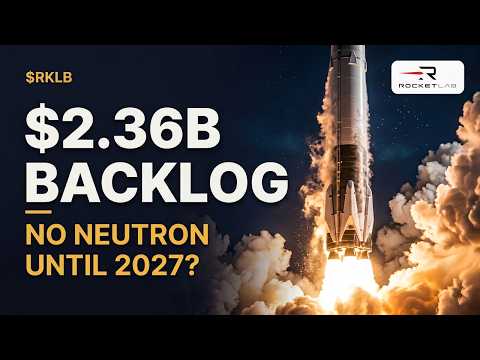
What does Rocket Lab do?
Rocket Lab USA, founded in New Zealand in 2006 and now headquartered in Long Beach, California, works on both sides of the space business: getting things to orbit, and building the things that go there.
- Launch. Electron is a small rocket for satellites of a few hundred kilograms, launched from New Zealand and from Wallops Island, Virginia. HASTE is a suborbital version used to fly hypersonic tests, mostly for US defense customers. Neutron is a medium-lift rocket designed to land its first stage and fly again, aimed at the constellation and national security launches that Electron is too small for.
- Space Systems. Rocket Lab builds satellite platforms (the "bus" a customer's payload sits on), complete spacecraft, and components sold to other satellite makers, such as solar panels, reaction wheels and star trackers. In the third quarter of 2026 it launched twelve spacecraft it had built, including eight satellite platforms for Globalstar and two spacecraft for NASA at Mars.
The combination is the pitch: a customer can buy the spacecraft and the ride from the same company.
How Rocket Lab makes money
The 10-Q splits revenue into product and service. In the third quarter of 2026:
| Q3 2026 | Q3 2025 | Change | |
|---|---|---|---|
| Product revenue (spacecraft, platforms, components) | $197.5M | $104.0M | +90% |
| Service revenue (launches and related services) | $70.3M | $51.0M | +38% |
| Total revenue | $267.8M | $155.1M | +73% |
Revenue came in above the company's own guide of $250M to $265M. Over nine months it reached $702.2M, against $422.1M a year earlier (+66%). For the fourth quarter, management guided $270M to $290M; added to the nine months, the midpoint puts 2026 revenue near $982M. That is a company guide, not a result.
Profit is the other side. GAAP gross margin was 33.6% in the quarter, down from 37.0% a year earlier. The operating loss was $79.2M and the net loss $79.7M, wider than a year ago, partly because of $21.3M of Iridium deal costs and a $27.3M loss on retiring convertible notes. The company's own adjusted EBITDA measure was a loss of $18.0M, narrower than the $26.3M of a year earlier.
The order book
The backlog is the strongest number in the filings. The remaining performance obligation was $3.573B at September 30, 2026, against $2.356B at June 30: $1.22B more in one quarter, or 52%. The release breaks out the new business:
- Launch. About $1B of new launch contracts across Electron, HASTE and Neutron, for a launch backlog of 117 launches.
- Neutron. Over $515M of Neutron contracts from constellation operators, for 16 missions booked before the first flight.
- Space Systems. $470M of new contracts, and more than 55 spacecraft in development and build.
Customers also paid ahead: contract liabilities rose to $423.6M from $195.4M in December, which helped GAAP operating cash flow turn positive at $7.2M in the quarter. Over nine months it was still negative, at -$127.3M, with $84.2M of capital spending.
The money behind the growth
Rocket Lab funds itself by selling shares. Proceeds from at-the-market equity sales were $3.91B over nine months of 2026, and common shares outstanding rose to 639.2M from 543.6M in December 2025. Most of that money is for Iridium: Rocket Lab pays $27 in cash plus Rocket Lab shares for each Iridium share, with the share part fixed at 0.4 below a Rocket Lab price of $67.50 and capped at about 42M new shares. The company says the deal is fully funded; closing is expected in 2027, after regulatory approvals.
The result is a large cash pile and a larger company to own: cash and equivalents of $4.45B at September 30, plus $256M of marketable securities, and about 681M basic weighted shares guided for the fourth quarter, including about 41M preferred.
Where it sits
$RKLB is the primary name of the Space / Sat Comms bubble and of the Space theme. Over 252 trading days, its tightest correlations in the QA universe include Firefly Aerospace ($FLY, 0.81), Intuitive Machines ($LUNR, 0.79), Redwire ($RDW, 0.77), Voyager Technologies ($VOYG, 0.74) and BlackSky ($BKSY, 0.73). They trade as one group: the listed space names rise and fall together on launch news and on risk appetite. The private name everyone compares Rocket Lab to is SpaceX; see SpaceX explained. The full, daily-refreshed peer table is on /stocks/rklb.
The numbers
| Close, 2026-11-20 | $45.42 |
| Record close, 2026-05-27 | $150.23 |
| Close a year earlier, 2025-11-21 | $40.30 |
| Market cap (QA data) | about $30.6B |
| Revenue, Q3 2026 | $267.8M, +73% |
| Revenue, nine months 2026 | $702.2M, +66% |
| GAAP gross margin, Q3 2026 | 33.6% |
| Net loss, Q3 2026 | $79.7M |
| Backlog, 2026-09-30 | $3.573B |
| Cash and equivalents, 2026-09-30 | $4.45B |
| Common shares outstanding | 639.2M |
The bull case
- The order book. A backlog of $3.573B, up 52% in a quarter, with 117 launches booked and more than 55 spacecraft in build.
- Demand for a rocket that has not flown. Over $515M of Neutron contracts for 16 missions before the first launch.
- Two businesses, one customer. Space Systems sells the spacecraft and the launch business sells the ride, so a customer can buy both.
- Cash. $4.45B of cash and equivalents at September 30, and the Iridium deal described by the company as fully funded.
The bear case
- Neutron timing. The first launch was a 2025 target, then late 2026, now no earlier than 2027; the 2026-10-14 delay came from a tank dome that has to be rebuilt.
- The loss. A GAAP net loss of $79.7M in the quarter and a gross margin that fell to 33.6%.
- Dilution. $3.91B of shares sold over nine months, and the Iridium deal adds up to about 42M more.
- The price of growth. At about $30.6B, the market value is roughly 31 times the 2026 revenue the guide implies (our arithmetic on a company guide), while large defense contractors trade near two times sales.
- A correlated group. The listed space names move together, so a bad day for the group reaches Rocket Lab whatever its own news.
How to access
$RKLB is held by space ETFs: the ARK Space Exploration & Innovation ETF (ARKX, about 5.4%), the Procure Space ETF (UFO, about 4.5%) and the ARK Autonomous Technology & Robotics ETF (ARKQ, about 3.9%), weights as of 2026-11-20. Buying one of them gives a slice of Rocket Lab inside a basket of space and technology names. The stock itself trades on Nasdaq; the brokers we use are on /stack.
The full teardown video is on /stocks/rklb. The desk's full read in one document, with eight quarters of SEC filings and the peer table, is the Rocket Lab Teardown Dossier, included in /pro, along with rule-based alerts on $RKLB. The third quarter in detail is in our Q3 2026 earnings recap.
What to watch
- Neutron. Integration and testing at Launch Complex 3 in Virginia, and a firm first launch date.
- Iridium. Regulatory approvals and the closing, which bring new shares and a new revenue line.
- Gross margin against the fourth quarter guide of 34% to 36% (GAAP).
- Next earnings. The fourth quarter and full year 2026, expected in late February on Rocket Lab's usual cadence (not yet confirmed by the company).
- Observable reference levels. The teardown marked the 50 day average, then $64.23, and $50.84, the lowest close after the Neutron delay; the stock closed below that line at $45.42 on 2026-11-20. These are observable reference levels, not trade levels or targets. The live level map is on /stocks/rklb.
Live data on this ticker: /stocks/rklb. Price, ETF holdings, correlations, the level map, bot positions.
QuantAbundance is educational research. Nothing here is investment advice. See /disclosures.
The full dossier
Included in ProThe RKLB teardown in writing, its SEC filings in one table, peers with numbers and the live level map, in one read.
See the dossierFrequently asked questions
- What does Rocket Lab do?
- Rocket Lab USA designs, builds and launches rockets, and builds spacecraft and spacecraft parts for other companies. It flies Electron, a small rocket for satellites of a few hundred kilograms, and a suborbital version called HASTE used for hypersonic testing. It is developing Neutron, a larger, partly reusable rocket whose first launch is targeted no earlier than 2027. Its Space Systems side builds satellite platforms, whole spacecraft and components such as solar panels and reaction wheels.
- How does Rocket Lab make money?
- Through launches and through spacecraft. In the third quarter of 2026 it reported record revenue of $267.8M, up 73% in a year: $197.5M of product revenue (spacecraft, satellite platforms and components, up 90%) and $70.3M of service revenue (up 38%). It is not yet profitable: the GAAP net loss was $79.7M in the quarter. Its backlog of contracted work reached $3.573B at September 30, 2026.
- What is Rocket Lab's Neutron rocket?
- Neutron is Rocket Lab's medium-lift, partly reusable rocket, built to carry far more than Electron and to compete for constellation and national security launches. Its first launch was once a 2025 target; in October 2026 Rocket Lab moved it into 2027 after finding a flaw in a carbon fiber tank dome. Even before flying, Neutron had over $515M of contracts for 16 missions by the third quarter of 2026.
- Why did Rocket Lab stock fall in 2026?
- The stock closed at a record $150.23 on 2026-05-27 and at $45.42 on 2026-11-20, 70% lower, though still above the $40.30 of a year earlier. The fall came with the Neutron delay into 2027, a wider loss, and a much larger share count: Rocket Lab sold $3.91B of new shares over nine months of 2026 to fund its purchase of Iridium, and common shares outstanding rose to 639.2M from 543.6M in December 2025.
Related bubbles
The desk behind this piece

Some of these are affiliate relationships. See disclosures.
Related research
- 5 min readRocket Lab (RKLB) Q3: record $268M revenue, backlog up 52% to $3.57B
- 7 min readHow to invest in the SpaceX IPO (SPCX), and what to buy if you can't get in
- 8 min readSpaceX IPO (SPCX): the $1.77T listing, what you're buying, and the space cohort
- 4 min readOndas Q3 2026: revenue $167.5M, backlog $835M, 2026 target lifted to at least $550M, 2027 set at $1.1B
Go deeper
Want more of these in your Google results? Add QuantAbundance as a preferred source.
Add to Preferred SourcesFollow $RKLB for free.
One email a day: the AI-trade watchlist, every new ticker teardown and the bubble shifts. Free, leave in one click.
Free when you join: the $HOOD Teardown Dossier (Robinhood Markets), the full desk file we sell in the shop. One per new reader.
No spam. One email per day max, unsubscribe in one click. Pro ($49/mo) includes every dossier and report in the shop.